Double-texting. Last-seen checks. The thread, read again.
The double-texting was never a willpower problem. It's a loop you can catch one text sooner.
- 1 the Flicker
- 2the Surgethe catch point
- 3the Reach
- 4the Recoil
- 5the Sediment
See the wave forming before it reaches the send button, so you can catch it a stage earlier than you do now. A private, guided map of your own loop, built in one sitting. Just you, no daily tracking.
$37, one time. Lifetime access. 60-day no-questions refund.
Self-guided. Grounded in published research from four fields. No daily tracking.

The text is sent. The silence is loud.
You've read your own last message four times now. Checked when they were last on. Opened the thread again, in case the little word under your bubble changed.
Each check buys you about a minute of calm. Then the wave comes back and collects, with interest.
You know this circuit. You've known about it for years. And knowing has never once made the phone easier to put down.
Why knowing better was never enough
Here's the part nobody laid out for you. A payoff that only lands sometimes is the hardest kind to stop. That's a fact about the schedule it runs on, not about the person running it.
Because the checking does pay, sometimes. A reply lands, or the little clues read safe, and the wave drops for a minute.
A loop that pays out on a random schedule survives insight, willpower, and every promise you've made yourself at 1 a.m. It's not a flaw in you. It's a loop that gets fed.
The spiral has a shape you can find
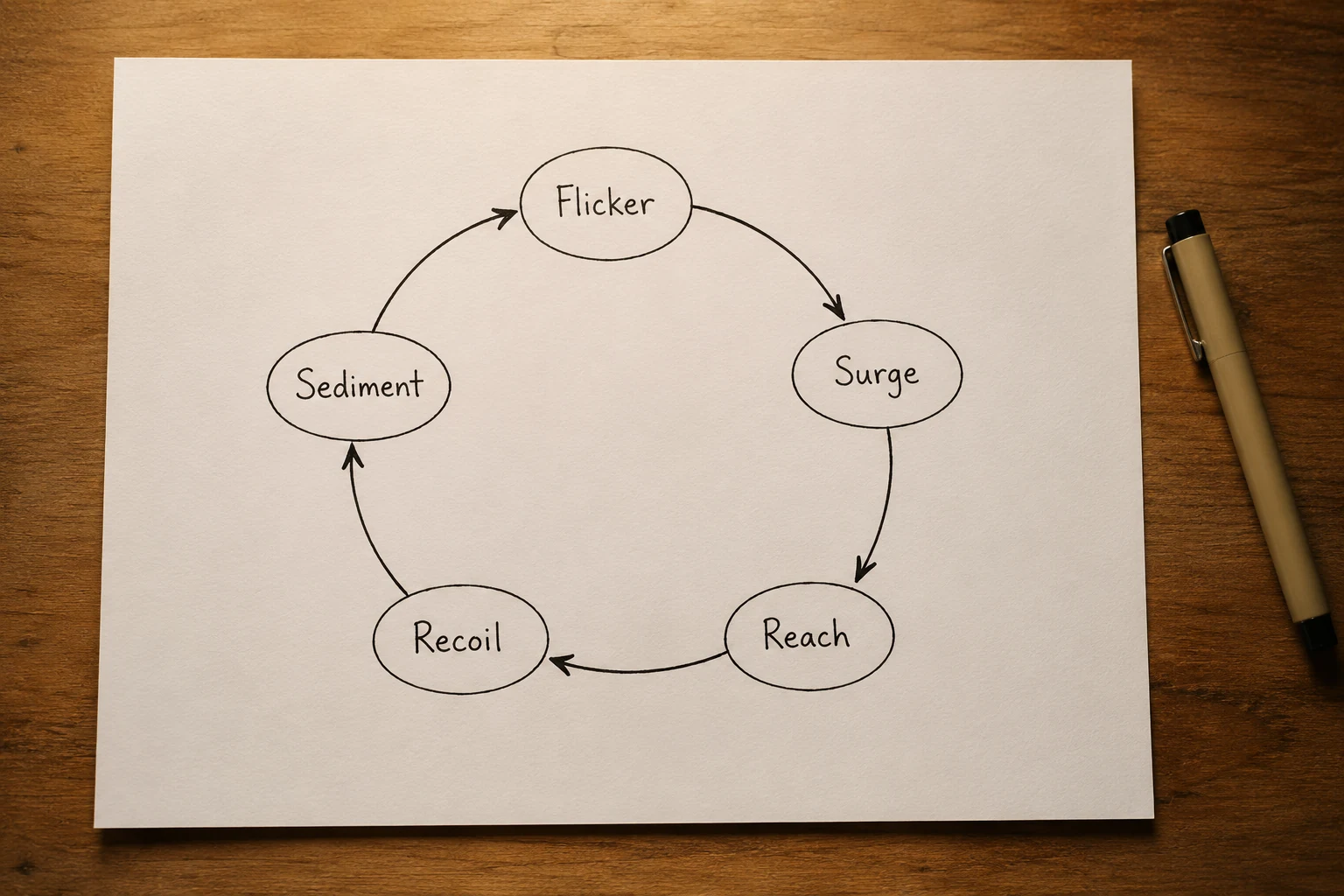
Laid out on paper, the loop turns out to have five stages. They run in order, every time, fast enough to feel like one single moment.
The Flicker.
Something touches your read on whether they're really there: a shorter reply, a seen with no answer, a plan gone vague. It's still just a thought. The body hasn't answered yet.
The Surge.
The body answers. Chest tight, restless, time going strange, and checking starts to feel like the only thing that will help.
The Reach.
You act: the second text, the call, the checking circuit. This stage includes the worst room in the loop, sent and unanswered, still surging while you wait.
The Recoil.
A response lands, or doesn't, and the damage registers. Pursuit reads as pressure. The shame arrives right on schedule.
The Sediment.
The story writes itself down: 'I always do this.' Each finished loop hardens it, and lowers the bar for the next Flicker.
Named like that, 'it happens too fast' stops being the end of the story. It becomes 'here is where I am in it.'
One wave, laid out
Take one ordinary Tuesday night.
She texts him something small and easy.
Read. No reply.
The Flicker. 'He saw it and didn't answer.' Just a thought, passing through. The body is still quiet.
The Surge. Chest pressure, up off the couch, ten minutes reading like an hour.
The Reach. Last-seen checked, profile opened, the thread re-read from the top. A follow-up drafted, deleted, drafted again, sent. Now it's two bubbles with nothing under them, and the surging-while-waiting begins.
His reply lands, light and ordinary. The Recoil: relief for one breath, then the cringe at her own screen.
The Sediment. 'I always do this.'
Five stages, one evening. If you recognized even two of them from your own last wave just now, you've already done the skill once. The Borrowed-Calm Map makes it systematic, on your own episodes.
Catch the flicker before the surge
Look back at that timeline. At 9:55 the whole thing was one passing thought. By 10:20 it was typing. That's the leverage rule, and it's the piece knowing your pattern's name never gave you.
A label says what you supposedly are. Location says where you are: which stage, at what speed, caught by which tell.
Early in the loop, a small move still works. Late in the loop, it stops working. Not because you got weaker, because the wave got taller.
Somewhere on those five stages is your catch point: the earliest stage you can currently spot while it's happening. If yours sits late, at the Reach or after, that isn't failure. That's just where detection starts before anyone shows you the map.
Not a label. A log.
You've been handed labels before: a type, a category, a fixed thing to be.
There's a good reason to distrust that label. When researchers lined up people's own read of their attachment against a trained assessor's read, the two barely matched. A label handed to you can be flat wrong. But what you actually did last Tuesday is not in doubt like that.
The Map doesn't do that. It logs what you actually did on your last few waves: the checking, the re-reading, the drafting and deleting.
Then it reflects the shape back. A self-inventory that changes the moment your behavior changes.
Two things become possible once the wave has a name. Putting what's happening into words takes some of the heat out, most at the early stages. And a plan gets writable: one if-then line, set down in advance for exactly your moment. That kind of pre-commitment has held up across ninety-some studies.
The Map's job is the half that has to come first: your stage, your tempo, your catch point, named plainly. That's what makes the line writable at all. So naming it can land a beat earlier, before the reach instead of after the recoil.
The Borrowed-Calm Map
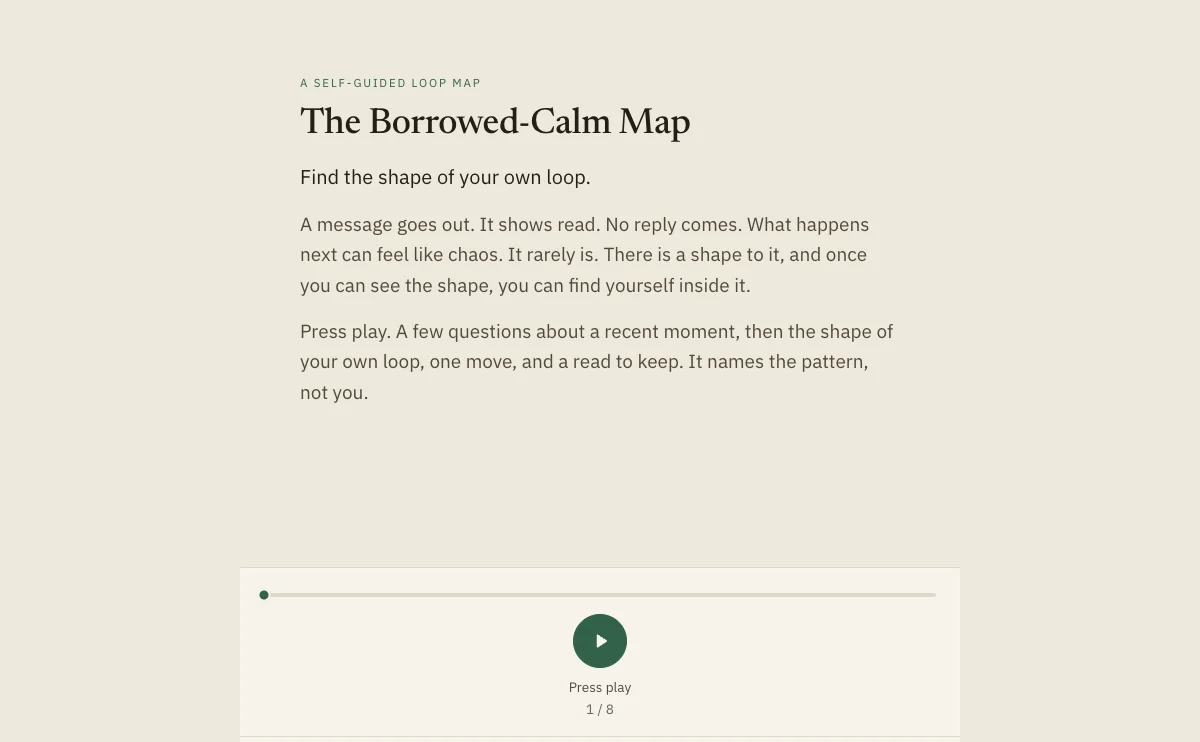
A private, self-guided map of your own loop. You answer a short set of questions about your last few episodes. It reflects back the shape of what you're running:
- Which stage you live in, the one your loop keeps pulling you back to.
- How fast yours runs, from first flicker to sent message.
- The one sentence that names what you keep doing.
Six companion guides come with it, each built for a specific thing this loop does to you, and each yours to download and keep:
Which Stage Do You Live In?
Your home stage, found, so "I can never tell where I am in it" stops being true.
Why It Keeps Winning
The borrowed-calm economics of your own loop: why knowing better was never enough.
How Fast Yours Runs
Your loop's real speed and window, seen as a shape instead of an ambush.
What This Is NOT
The line between a loop you run and a self you are, drawn cold and up front.
Is This Even My Pattern?
The fit check, answered before anything else: whether this map applies to you at all.
You Are Not the Only One Who Runs This
Your exact behaviors as the loop's known signature, not your secret defect.
The Map opens on your device the moment checkout clears. Nothing to install, and no account to keep. What you tell it stays on your device, never in a database of ours. No daily tracking. Yours to come back to as the picture changes.
Everything you get with the Map, and what each piece is worth on its own:
- The Borrowed-Calm MapActual value $127
- Which Stage Do You Live In?Actual value $27
- Why It Keeps WinningActual value $27
- How Fast Yours RunsActual value $27
- What This Is NOTActual value $24
- Is This Even My Pattern?Actual value $24
- You Are Not the Only One Who Runs ThisActual value $19
Total value: $275. Yours today for $37.
The Map itself is a $127 tool, more than three times what this page costs, and all six guides come with it.
$37. One time.
$37, one time. 60-day no-questions refund.
What actually changes, and what won't
What moves is where you catch it. Across waves, detection can walk one stage earlier. The episode you used to meet at the Recoil can get caught at the Reach, then at the Surge. Until the spiral stops being the automatic ending of a quiet evening.
And here is what the Map won't do, said plainly. It won't stop a wave mid-surge; nothing on a screen will. It's not therapy, and there's no clinical read of you anywhere in it. It maps what you did, never who you are.
And it asks nothing of your partner, not even that they know. Sixty days, no questions, if that trade is not one you want to keep.
Before you decide
Will it stop the spiral tonight?
No. Anything that says yes is selling you borrowed calm. What it does tonight is show you where you are in the wave, in one sitting. What changes after tonight is where you catch the next one.
I've done the quizzes. I already know my pattern.
Knowing the name is a fact you already had. The Map works the next forty minutes: the stage you're in, the speed it's moving, the tell that gives it away. Location is the part a label was never built to deliver.
How long does it take?
One sitting, about forty minutes, to lay out your last episode and find your stage. A fuller read of your own loop builds over your first week of using it, as you map more than one wave.
What if my worry is sometimes right?
Sometimes it is. The Map never grades whether a concern is true; that call stays yours. Its job is the other thing: the wave that collects you whether or not the worry checks out.
Do I have to work it every day?
No. There's no tracker, no streak, no daily anything. You lay out an episode when one happens, or when you decide to look. It's a map, not a regimen.
How long do I keep it?
Lifetime access, for as long as the Map exists. Your read also prints to a keepsake you save to your own device. The part you build is yours to keep for good.
Is this therapy?
No. It's educational and self-guided, and it never stands in for a professional. If you're in real distress, the resources at the bottom of this page are for that.
You'll check again tonight. That's not a verdict on you; it's how a fed loop runs. The difference is whether the wave has a map when it comes. One sitting. Your own words. The earliest stage you can catch, named. $37, one time. Sixty days, no questions.
Get the map$37, one time. 60-day no-questions refund.