You know sending another text probably won't help. So why is it so hard not to? It's not weakness. It's timing.
- 1the Flicker
- 2the Surgethe catch point
- 3the Reach
- 4the Recoil
- 5the Sediment
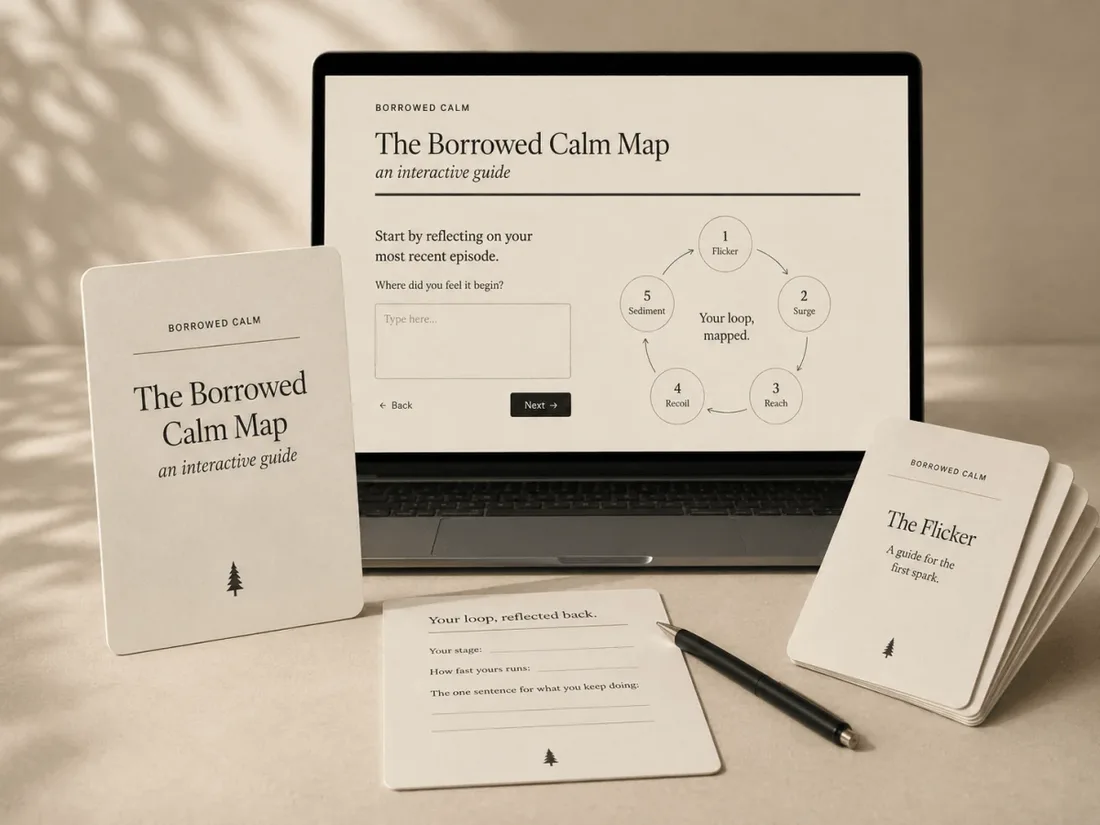
The Borrowed Calm Map shows you what happens between "no reply yet" and the moment you reach for your phone again, so you can spot the pattern before you act on it.
No labels. No diagnosis. Just your pattern, made clear.
$39one-time
Unlock My Loop Map for $39One-time payment · No subscription · Lifetime access · 60-day money-back guarantee · Private by design · Research-backed · Nothing to install
It usually doesn't start with the text you regret.
It starts smaller.
A reply takes longer than usual.
The message feels a little shorter.
You notice they were online.
You tell yourself it probably means nothing.
Then you check again.
You reread what you sent.
Nothing looks obviously wrong.
And somehow that makes it worse.
So you look harder.
Was the joke too much?
Did the tone change?
Did you sound too eager?
You put the phone down.
Pick it back up.
Open the thread again.
Start writing something casual.
Delete it.
Try something even more casual.
And somewhere in the middle of all that...
one unanswered message becomes something you feel like you need to fix.
Right now.
The Borrowed Calm Map helps you see and understand what happened before all of that.
Look, does this sound familiar?
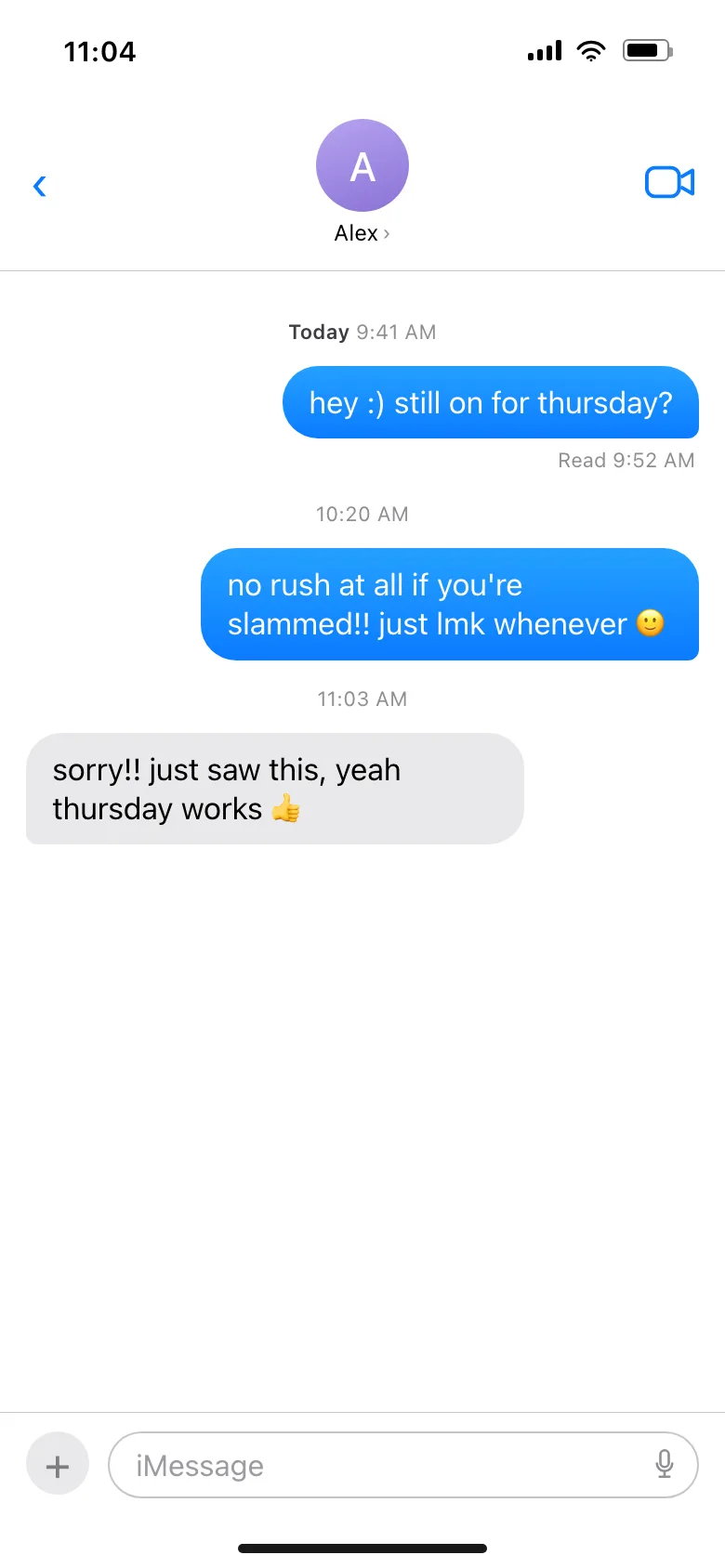
One ordinary thread, and the ninety-nine minutes underneath it, with the loop finally showing.
You text them something small.
Read, no reply.
The first small doubt lands, the Flicker. It's still just a thought. Your body hasn't caught up yet.
Chest tight, up off the couch, ten minutes feels like an hour. That's the Surge.
You check the last-seen, open their profile, read the thread from the top, draft a follow-up, delete it, send it anyway. That's the Reach.
They reply, short and ordinary. Relief for a second, then you read your own messages back. That's the Recoil.
"I always do this." That's the Sediment.
Every check works. That's the whole trap.
Each reply, each last-seen, each reread buys you a moment of calm right now.
But that calm is borrowed. The next wave collects it back with interest, then asks for one more.
That's why knowing better never ended it. And why, laid out like this, you can finally watch the trade happen.
One-time payment · Lifetime access · 60-day money-back guarantee
Once you can see the loop, it gets a lot harder to mistake it for one random moment.
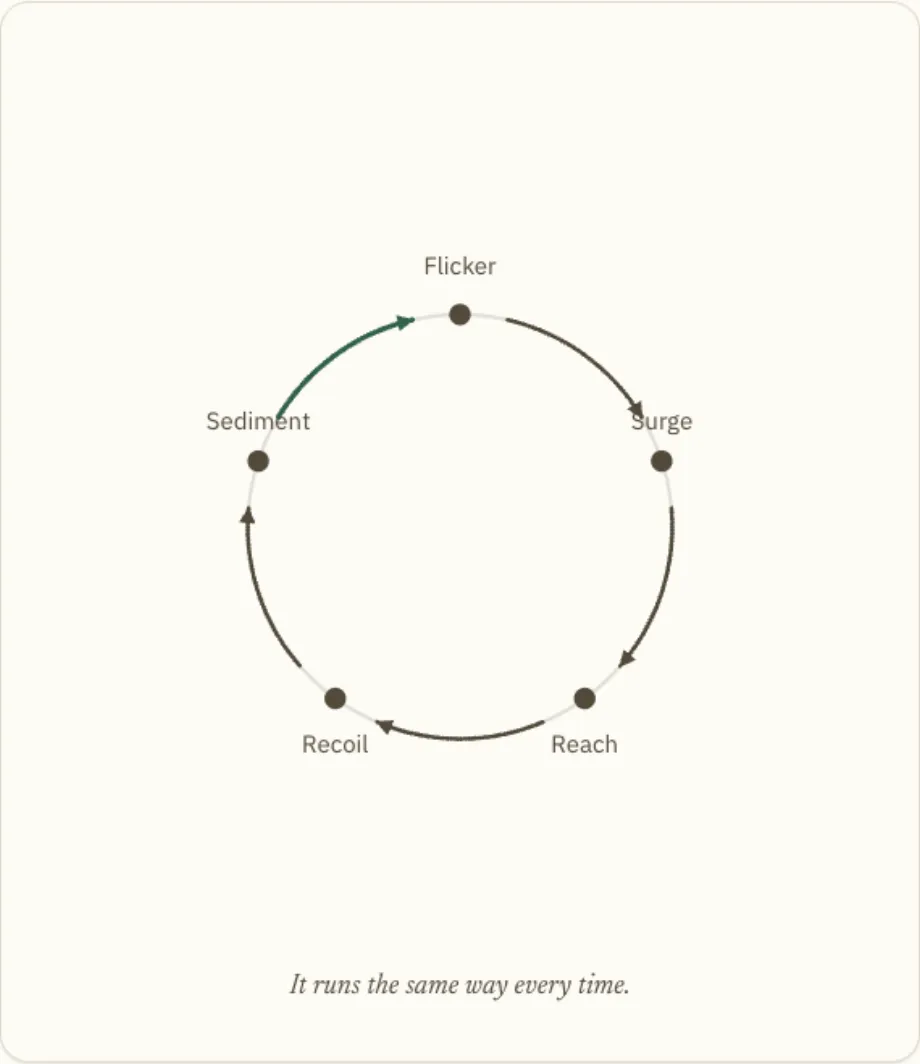
Before actions you might regret, there can be a whole chain of small moments. The Borrowed Calm Map gives that chain a simple structure.
Something changes. A slower reply. A different tone. A quiet morning.
Your mind starts filling in the missing information. "What changed?" "Did I do something?" "Are they pulling away?"
You do something to make the uncertainty easier to sit with. Check. Open the thread. Look at last seen. Draft another message.
The relief doesn't last. Now there's something new to think about. "Did I make it worse?" "Should I delete that?" "Why did I send it?"
The moment passes. The pattern stays. And next time, it can happen even faster.
The Borrowed Calm Map helps you trace your version of that loop using a real moment from your life.
Not somebody else's pattern.
Yours.
Their advice wasn't wrong. It was late.
"Don't double text."
"Put your phone away."
"Just wait."
"Stop checking."
"Have some self-control."
"Give them space."
None of that's crazy advice.
It's just much harder to use when your mind is already drowning deep into the pattern.
By then, you're trying to stop the last step.
The Borrowed Calm Map helps you look earlier.
At the little change you noticed.
The meaning your mind gave it.
The urge that followed.
The thing you did to feel better.
That's where the pattern becomes easier to see.
The goal isn't to become someone who never cares.
It's to notice what's happening sooner.
Before
- No reply.
- Check phone.
- Check again.
- Read the thread.
- Start guessing.
- Draft something.
- Delete it.
- Send something else.
- Regret it.
With the map
- No reply.
- Notice the flicker.
- Catch the story starting.
- Recognize the urge to reach.
- See the familiar pattern.
- Decide what you want to do next.
The situation may be the same.
Your view of what's happening inside it doesn't have to be.
One-time payment · Lifetime access · 60-day money-back guarantee
But this isn't another lesson you just take and forget.
The Borrowed Calm Map is interactive.
It teaches.
Then it facilitates discovery.
You answer.
Then what you entered shapes what comes next.
And the process continues from there.
So instead of sitting through one generic lesson made for everyone...
you work through one real moment from your own life.
A missed reply. A change in tone. A message that felt different. A moment you kept replaying.
What you noticed. What you thought. What you checked. What you wanted to do. What you actually did.
What you enter determines what part of the guided lesson appears next.
What felt like one messy moment starts to look like a sequence. And a sequence is much easier to notice than a blur.
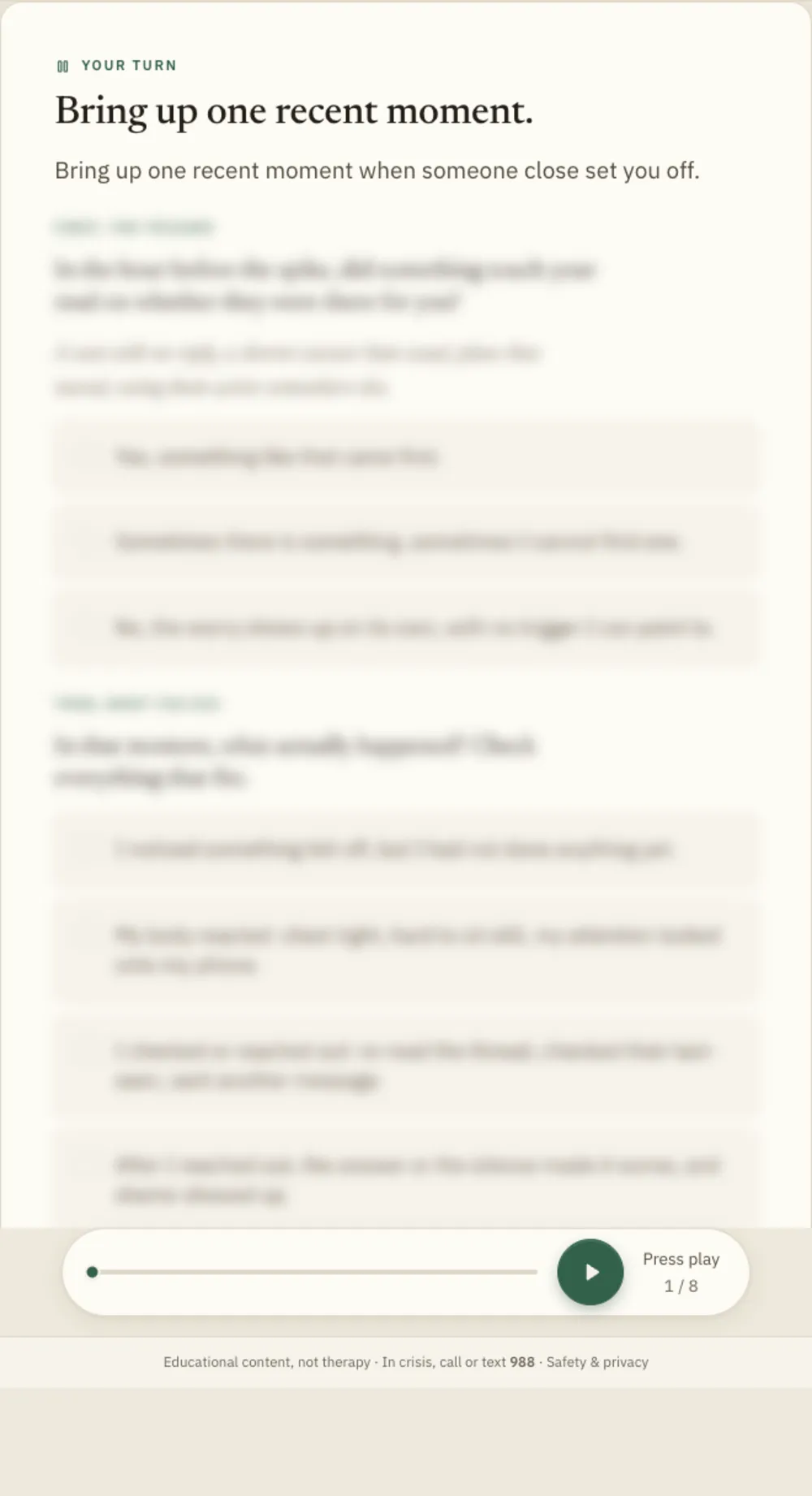
Guided, personalized walkthrough of your own loop.
It's never been easy finding help this specific.
A general course would take on the whole subject instead. Attachment. Anxiety.
The wide topic, taught to a wide room, the same lesson handed to everyone in it.
While the Borrowed Calm Map is built around one exact situation:
- The checking.
- The rereading.
- The second text sent before the first one's answered.
The narrow loop you actually run. Not the wide topic it sits inside.
The five stages come from a framework built on published research.
That research is the credibility. The read is yours alone.
So you don't walk away with a definition to memorize.
You walk away holding three things. Your stage, your one move, and a read you keep.
One-time payment · Lifetime access · 60-day money-back guarantee
Private by design. Because some thoughts don't need to become stored history.
The interactive Borrowed Calm Map experience runs in your own device.
The personal answers you enter into the experience aren't saved in our database. It stays with you.
They are used while you are there to guide what appears next.
Your purchase and member access still exist so you can return to the product.
Your private reflections don't need to become a saved profile just to make the experience work.
You bring the moment.
You work through it.
That is enough. No privacy sacrificed.
Who this is for, and who it isn't.
This is for you if:
- You check the last-seen, reread old threads, and send the second text before the first is answered.
- You've tried to just stop, and just stopping has never held.
- You want to understand what you keep doing, and why, in plain language.
This isn't for you if:
- You're looking for therapy or treatment for a clinical condition. This isn't that.
- You want the other person changed or managed. This reads your loop, not them.
- You want a quick willpower hack to power through it. Willpower was never the missing piece.
The Borrowed Calm Map
A personalized guided process that helps you trace one real moment from the first flicker through what happened next.
- No-fluff lessons on exactly how your loop works
- Guided prompts that walk you through the moment
- Your completed five-stage map
- Your one move, to use while the loop is still running
- A read to keep, yours to save and print and open again
- Your loop answers stay in your browser, not saved to any account or database of ours
And your purchase today includes a complimentary addition: The Deep Dive Pack
These are not worksheets required to finish Borrowed Calm.
The core interactive experience is complete on its own.
The Bonus Library gives you separate resources you can open whenever one becomes useful.
Each bonus is presented as a premium digital flipbook inside your member area.
Read it there.
Or download the PDF and keep your own copy.
Which Stage Do You Live In?
You likely live in one stage more than the rest, and the one you keep landing in tells you something specific about your loop.
Why It Keeps Winning.
The single reason knowing better was never enough to end it, and why that was never a fault in you.
How Fast Yours Runs.
Some loops take days, some take minutes. Yours has a speed, and reading it tells you how much warning you actually get.
What This Is NOT.
The line between a loop you run and a person you are, and why it's so easy to get this backwards.
Is This Even My Pattern?
A clean way to tell whether this is your loop or just a rough week, before you spend another round of it assuming the worst about yourself.
You Are Not the Only One Who Runs This.
The exact moves you thought were only yours, laid out as the loop's known signature, so the private ones stop feeling like proof something's wrong with you.
$39 one-time. No subscription. Instant access, nothing to install, yours to keep for life. Your answers stay on your device, and they never reach a database of ours.
One-time payment · Lifetime access · 60-day money-back guarantee
You don't need to know anything about attachment styles to use this.
The Borrowed Calm Map is built around what actually happened.
What you noticed.
What you thought.
What you did next.
You don't need the right label.
You don't need to diagnose yourself.
You don't need the other person to take part.
You just need one real moment you want to understand more clearly.
Or get all your money back.
One-time payment · Lifetime access · 60-day money-back guarantee
Get the complete Borrowed Calm Map experience for only $39.
One purchase gives you:
- The complete interactive guided program
- The five-stage Borrowed Calm Map process
- Personalized guided discovery
- A private-by-design in your own device
- Your premium member area
- Instant lifetime access
- Complimentary Deep Dive Pack
$39one-time
60-Day Money-Back Guarantee.
Straight answers, before you decide.
Is Borrowed Calm therapy?
No. The Borrowed Calm Map is an educational self-reflection interactive online course. It doesn't diagnose or treat mental health conditions, and it doesn't replace professional mental health care.
Is this an AI chatbot?
No. The Borrowed Calm Map follows a guided interactive process. The answers you enter determine your personalized experience. You aren't having an open-ended conversation with an AI therapist.
Does Borrowed Calm save what I type?
The interactive Borrowed Calm Map experience doesn't save your personal answers or progress as a reflection history. What you enter is used in your browser to shape the experience while you're using it. Your purchase and member access still exist so you can return to it whenever.
Do I need to know my attachment style?
No. The Borrowed Calm Map starts with what actually happened. You don't need to diagnose yourself or choose a label first.
Does the other person need to take part?
No. Borrowed Calm focuses on your side of the moment.
Do I need the bonus PDFs?
No. The Borrowed Calm Map is complete without them. The Deep Dive Pack contains separate resources for when you want to explore something further.
Can I download the bonuses?
Yes. The available bonus resources can be read as digital flipbooks or downloaded as PDFs.
Is there a subscription?
No. This is a one-time $39 purchase.
Can I come back and use it again?
Yes. Your purchase gives you access for as long as Borrowed Calm Map remains available.
What does "access for the life of Borrowed Calm" mean?
Your one-time purchase gives you access for the lifetime of the Borrowed Calm product. There is no recurring subscription.
What exactly do I receive for $39?
The Borrowed Calm Map plus the full Deep Dive Pack of six guides. Your stage named out of five, your one move, and a read you can save and print. Everything unlocks the moment you buy.
What if I don't find it useful?
You have 60 days to get every dollar back, no questions asked. Keep the guides.
The next quiet moment probably won't announce itself.
A reply may take longer.
A message may feel different.
Something small may change.
And before long, the old path can start moving again.
You don't need to promise yourself that you'll never check again.
You don't need another rule.
Start by seeing what happens before the rule becomes hard to follow.
That's what the Borrowed Calm Map is for.
$39, one time.
One-time payment · Lifetime access · 60-day money-back guarantee
What the Borrowed Calm Map is built on
The five stages come from a framework built on published research. Every source is listed on one page, along with what the research supports and where its limits are.
The full sources, named, with what each does and doesn't show.